Blog
Perspectives from NANT Global Finance on capital markets and blockchain infrastructure.
November 13, 2026
Smart Contracts: What They Can and Cannot Do
A smart contract is code that carries out rules exactly as written. Ethereum's documentation defines it as a program that runs on the blockchain, made of code (its functions) and data (its state) at a specific address. No user controls it. Once deployed, it runs as programmed, and it can define rules like a regular contract and enforce them automatically.¹ For securities, the useful questions are what that automation handles well and where it stops.
Read articleNovember 6, 2026
DTCC’s Tokenization Service Is Live
On October 28, 2026, the Depository Trust Company (DTC), a subsidiary of DTCC, launched the DTCC Tokenization Service (DTS).¹ DTCC described the launch as “the culmination of years of work” to bring tokenized securities into a regulated framework.¹
Read articleOctober 29, 2026
Nasdaq Raises the Bar for Capital Market Listings: $4.00 Is Now the Minimum
On September 30, 2026, Nasdaq filed a rule change that removes the last path for listing on the Nasdaq Capital Market at a price below $4.00. The SEC posted notice on October 7. The change took effect on filing, and Nasdaq intends to make it operative 30 days after filing, which is about October 30.¹ Going forward, every company listing under the Initial Listing Standards on the Capital Market will need a minimum price of $4.00.¹
Read articleOctober 22, 2026
Tokenized Shares on NYSE: What the Rule Covers and What It Leaves Open
NYSE's tokenized securities rule changes how a trade settles, not what is being traded. A member firm can flag an eligible order so that it settles as a token on a blockchain instead of in traditional form, and everything else about the order stays the same.¹ NYSE filed the rule on April 9, 2026. On April 17, the SEC published a notice of filing and immediate effectiveness, which means the rule took effect on filing without a separate approval order. The Federal Register followed on April 22.¹ ² The filing gives no start date. It says tokenized trading begins only once the Depository Trust Company (DTC) has its settlement infrastructure in place, and that member firms will get at least 30 calendar days' notice in a Trader Update.¹
Read articleOctober 16, 2026
The Oracle Problem: How a Blockchain Learns About the Outside World
You may have heard of the oracle problem before. To understand it, you first need to know what an oracle is and why a blockchain needs one.
Read articleOctober 9, 2026
What Makes a Blockchain “Public” vs. “Permissioned”?
The word “blockchain” gets used as if it describes one thing. It doesn't. One of the first distinctions worth understanding, before anything about consensus mechanisms or smart contracts, is the difference between a public blockchain and a permissioned one, because that single design choice shapes almost everything else about how a network behaves.
Read articleOctober 2, 2026
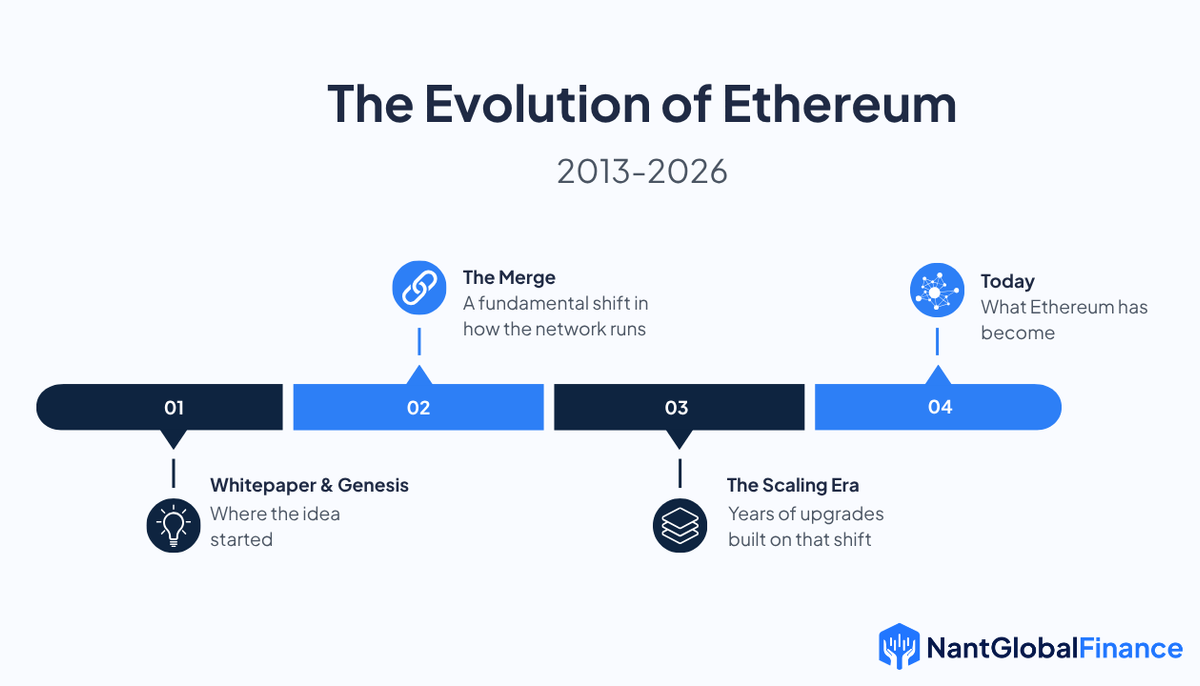
The Evolution of Ethereum
Ethereum turned 11 this past July, and the network looks almost nothing like the one that mined its first block in 2015.
Read articleSeptember 24, 2026
Behind the broker dealer: Becoming a FINRA Member
Our "What It Takes to Stay Public" series looked at the issuer side of the market. This series looks at the other side, the broker-dealers who execute trades, hold accounts, and carry the regulatory weight of standing between an investor and the market itself. It starts at the entry point: what it actually takes to become a FINRA member before a firm can do any of that at all.
Read articleSeptember 17, 2026
What It Takes to Stay Public: The Layers Depend On Each Other
Over five parts, this series has walked through SEC reporting, exchange listing standards, governance and internal controls, shareholder recordkeeping, and the market infrastructure underneath all of it, largely as separate layers. They aren't separate in practice. These obligations reinforce each other, and a gap in one layer tends to show up in more than one place at once.
Read articleSeptember 11, 2026
What It Takes to Stay Public: Market Infrastructure & Technology Readiness
The first four parts of this series covered what the SEC requires, what the exchanges require, the governance layer connecting both, and the transfer agent infrastructure that carries out shareholder recordkeeping day to day. This piece asks a different question: what happens when the infrastructure itself changes underneath a company that's already public. Two regulatory developments this month make that question immediate rather than theoretical.
Read articleSeptember 3, 2026
What It Takes to Stay Public: Shareholder & Record-keeping Infrastructure
The first three pieces in this series covered what the SEC requires, what the exchanges require, and the governance layer that supports both. This article looks at a different question: once all of that is written down as a requirement, who actually carries it out day to day. That answer, in large part, is the transfer agent.
Read articleAugust 27, 2026
What It Takes to Stay Public: Corporate Governance & Internal Controls
The first two pieces in this series covered the reporting rules the SEC sets and the ongoing thresholds exchanges enforce. Both of those depend on something that happens further back, inside the company itself. A board has to be structured a certain way. Committees have specific jobs to do. Internal controls have to actually catch problems before they show up in a filing. This is the third piece in our series on what staying public actually requires, and it covers that governance and internal controls layer: the board and committee structure, and the systems that keep financial reporting accurate.
Read articleAugust 20, 2026
What It Takes to Stay Public: Exchange Listing Standards (NYSE vs NASDAQ)
The SEC sets the reporting rules every public company has to follow. The exchange your stock trades on sets a separate, ongoing set of requirements, and falling short of either one can get you delisted. This is the second piece in our series on what staying public actually requires. Here's what it takes to remain in compliance with NYSE and Nasdaq once you're already listed.
Read articleAugust 13, 2026
What It Takes to Stay Public: SEC Reporting Compliance
The IPO is the part everyone plans for. Ringing the bell, watching the ticker for the first time, closing the raise. What comes next gets a lot less attention, and it's arguably the harder part. Staying in good standing with the SEC, quarter after quarter, for as long as the company is public. Therefore, we are starting a series on what staying public actually requires.
Read articleAugust 6, 2026
Nasdaq’s $5M Delisting Fast-Track Is on Hold: What the Pause Means for Micro-Cap Issuers
On July 22, 2026, the SEC approved Nasdaq's rule change. One week later, the Commission stayed it, following notices of intent to petition for review.
Read articleJuly 30, 2026
The World's Biggest Markets Can't Agree on How to Tokenize a Security
A blockchain can move a security in seconds. What it can't do on its own is decide who holds the legal claim once it moves, and right now, the world's largest regulators are answering that question in different ways, on different timelines.
Read articleJuly 23, 2026
What Cross-Border Participation in U.S. Markets Actually Requires
U.S. equities have never been more accessible in theory. Foreign ownership has reached $16.8 trillion, representing 17.8% of U.S. equities and up 97% since 2019.¹ Retail investors globally put $1.3 billion per day into U.S. markets in the first half of 2025, up 32.6% from the same period in 2024.² The demand is not the question. What sits between a global investor and a U.S. equity is.
Read articleJuly 17, 2026
Transfer Agents Just Asked the SEC to Decide Who Actually Owns a Tokenized Share
The Securities Transfer Association (STA) sent the SEC a letter this month arguing that tokenized shares authorized by a company and recorded in its own shareholder register should get different treatment than tokens created by outside platforms.¹ It's a direct response to something the SEC put out back in January. Staff from the Divisions of Corporation Finance, Investment Management, and Trading and Markets issued a joint statement describing two ways securities are showing up on blockchains today: ones tokenized by or on behalf of the issuer, and ones tokenized by a third party with no direct tie to the company at all.²
Read articleJuly 9, 2026
DTCC Just Went 24x5. Here Is What the Infrastructure Behind That Actually Requires.
DTCC's National Securities Clearing Corporation is now live with 24x5 clearing, running from Sunday at 8:00 PM ET through Friday at 8:00 PM ET.¹ For anyone watching how U.S. market infrastructure has been evolving, this is a moment worth paying attention to.
Read articleJuly 2, 2026
What Does the SEC's Proposed Rescission of the Trade-Through Rule Mean for Capital Markets?
On June 11, 2026, the SEC unanimously proposed rescinding Rule 611 of Regulation NMS, the order protection rule that has required stock trades to execute at the best available price across venues since its adoption in 2005. Also known as the trade-through rule, Rule 611 prohibits executions at prices inferior to protected quotations displayed on other trading venues. The proposal would eliminate that requirement entirely, along with Rule 610(e), which governs locked and crossed markets. Chair Atkins, who voted against the rule at its original adoption, framed the proposal around a straightforward argument: the market that Regulation NMS was built for no longer exists.
Read articleJune 25, 2026
The SEC Proposes Raising the Large Accelerated Filer Threshold to $2 Billion
On May 19, 2026, the SEC issued proposing releases that would consolidate the current filer categories into two: large accelerated filers and non-accelerated filers. The proposal would raise the threshold for large accelerated filer status from $700 million to $2 billion in public float and extend scaled disclosure accommodations to a much broader set of issuers.
Read articleJune 18, 2026
What the SEC's Tokenization Guidance Means for Issuers and Their Transfer Agents
Tokenization is reshaping how securities are issued and recorded. What it has not changed is the legal weight of the transfer agent's role underneath it. The SEC's January 2026 statement on tokenized securities made that clearer: tokenization represents a change in technological process but not in the underlying legal analysis under securities laws. The format in which a security is issued or the method by which holders are recorded, on-chain or off-chain, does not affect the application of federal securities laws.
Read articleJune 11, 2026
The SEC Paused Tokenized Stock Exemption. Here Is What Issuers Should Know.
The SEC reportedly postponed its planned innovation exemption for tokenized US stocks, and the reason behind the delay matters more than the delay itself. According to reporting from Phemex, Nasdaq, NYSE, and Cboe raised concerns about the draft creating a parallel trading system operating outside the regulatory framework existing exchanges and trading venues already follow. Notably, those same exchanges had already filed separately to support tokenized securities within existing market infrastructure. The pushback was not against tokenization itself. It was against doing it outside existing regulated infrastructure. That distinction is what every issuer should be paying attention to.
Read articleJune 4, 2026
NYSE American Just Raised the Bar for Microcap Issuers
The SEC approved significant amendments to Sections 101 and 102 of the NYSE American Company Guide, raising listing standards across float quality, pricing, and uplisting eligibility. For many microcap companies, historical financing structures that once supported exchange eligibility may no longer satisfy the new requirements. Companies considering IPOs or uplistings may now need to reassess float structure, shareholder composition, and operational readiness much earlier in the process.
Read articleMay 28, 2026
Nasdaq Proposes Stricter Listing Rules for IPOs, Uplistings, and China-Based Issuers
Over the past year, Nasdaq has pushed through a series of rule changes that collectively raise the bar for getting onto the exchange and staying there. Two of those changes have now received SEC approval, while a third remains under review. Taken together, they represent the most significant overhaul of Nasdaq's initial and continued listing standards in recent years. Companies planning a Nasdaq IPO, uplisting, or business combination need to understand all three pieces.
Read articleMay 21, 2026
24/7 Trading and What It Means for Capital Markets Infrastructure
Capital markets have historically operated within fixed windows, but the assumption is being challenged. On April 10, 2026, the SEC approved Nasdaq's proposal to extend trading hours for U.S. equities and ETPs to 23 hours a day, five days a week, moving Nasdaq from its current 16-hour schedule to a nearly continuous 23/5 model.¹ NYSE and other exchanges are also expanding infrastructure for extended trading hours.
Read articleMay 14, 2026
Why Ethereum is Emerging as the Infrastructure Layer for Capital Markets
Market participants are increasingly concentrating around shared infrastructure, and that concentration is beginning to define which networks become the foundation for the next phase of capital markets. Ethereum is emerging as a primary network for tokenized real-world assets, currently holding approximately 61% market share with over $206 billion in settled volume and 40% year-over-year growth. Total distributed asset value across tokenized real-world assets now exceeds $30.9 billion globally.¹ At Nant Global Finance, we view this shift through the lens of how issuers, trading venues, broker-dealers, and ownership infrastructure increasingly connect across shared networks.
Read articleMay 8, 2026
The Evolution Of Capital Markets
Capital markets have always evolved, but the pace and nature of change underway today is different. The infrastructure that runs today's markets was built around physical and operational constraints that no longer exist in the same form. Fixed trading hours, multi-day settlement, siloed recordkeeping, and geographic barriers to access were not design choices. They were practical limitations of their time. Technology, regulation, and market demand are now converging to challenge those assumptions at the same time.
Read articleApril 30, 2026
What It Actually Takes to Participate in Tokenized Markets
Our first three blogs covered tokenization as a concept, the trading mechanics, and the evolving regulatory framework. The practical question participants are now sitting with is how to actually connect to this opportunity. Regulatory clarity is improving, pilot frameworks are emerging, and infrastructure is moving closer to production. The DTC pilot rollout is targeted for the second half of 2026.¹ The NYSE has filed its own proposal to trade tokenized securities under the same DTC pilot framework.² Knowing tokenized markets are coming is no longer the work. Knowing how to participate is.
Read articleApril 23, 2026
What the Regulatory Framework for Tokenized Securities Actually Says
The regulatory framework around tokenized securities is no longer a question mark. The SEC has now spoken directly to how existing federal securities laws apply, and the answer is consistent with what many market participants expected: tokenization changes the format and the recordkeeping mechanism, not the legal status of the security. The same registration requirements, investor protections, and trading rules apply regardless of format.
Read articleApril 16, 2026
What Trading Looks Like on Tokenized Infrastructure
Trading is the most visible part of capital markets, and it is the area where tokenization is creating the most immediate change for participants. As tokenization moves closer to core market structure and out of the experimentation phase, understanding what is actually changing in practice matters more than the concept itself. Nant Global Finance, through its subsidiaries, has been building toward this infrastructure for nearly over seven years.
Read articleApril 9, 2026
What does Securities Tokenization mean today?
Tokenization of securities is moving from early experimentation into active adoption. For years, the concept of representing securities on blockchain infrastructure existed largely as a proof of concept. That is changing. Market infrastructure providers including Nasdaq, NYSE, and DTCC are now actively exploring blockchain across issuance, trading, and settlement, not as future roadmap items, but as current development priorities.
Read article